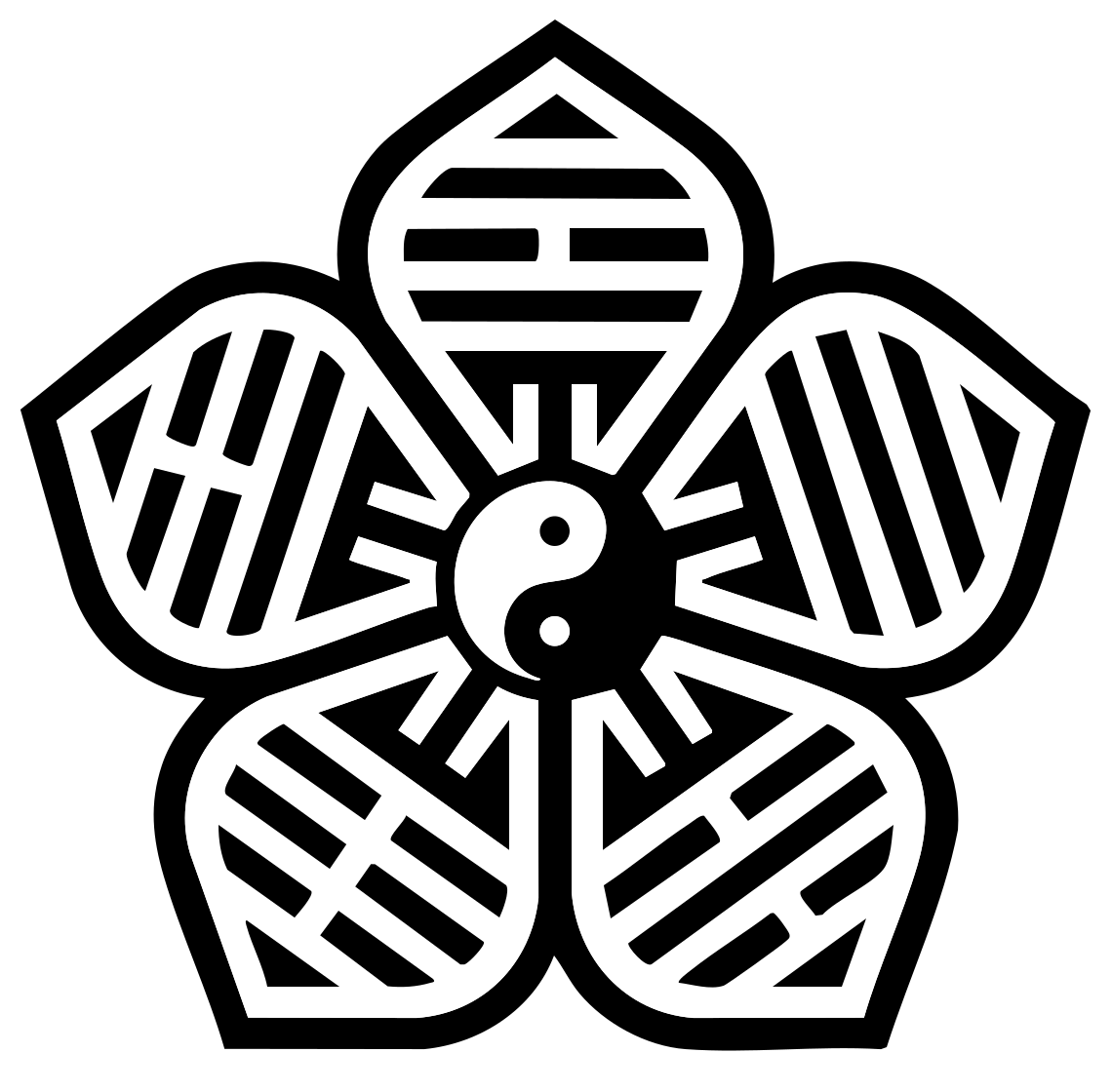
The I Ching, sometimes spelled Yijing, is the oldest of the Chinese classics. People have been consulting it for roughly a hundred generations. It is slow, patient, and often eerie in its accuracy.
Where it came from
The received text dates to the Western Zhou dynasty, around 1000 BCE, and is traditionally attributed to King Wen and the Duke of Zhou. Confucius is traditionally credited with the Ten Wings, a set of commentaries that turned a divination manual into a work of philosophy. By the Han dynasty it had become the first of the Chinese classics.
For most of its life it has been read as both: a practical oracle, and a description of how change itself behaves.
A book is not the same as a method. The I Ching is both.Asaf, HexWave CEO
How it's built
The whole system is made of one shape, repeated: a line. A line is either yang (unbroken) or yin (broken). Stack three lines and you have a trigram. Eight trigrams exist, one for each of the elemental situations the old Chinese cosmology recognised: Heaven, Earth, Water, Fire, Thunder, Wind, Mountain, Lake.
Stack two trigrams and you have a hexagram. Six lines, 64 possible combinations, each with a name, a judgment, an image, and six line-texts describing what happens as pressure shifts from the bottom of the situation to the top.
- 乾
- 兌
- 離
- 震
- 巽
- 坎
- 艮
- 坤
The Creative
Six yang lines. The hexagram of initiating force. The text describes the four stages of any strong beginning: arising, emerging, acting, pausing.
How it's cast
Traditionally: using 49 yarrow stalks, sorted by hand in a ritual that takes the better part of an hour. Later: three coins, tossed six times. Later still: a computer, running a deterministic calculation on the moment of your birth. The method is not the point. The point is generating a hexagram from a slice of this moment, so that you can read what kind of moment it is.
The I Ching does not answer questions. It describes the situation in which your question is happening.
How it's read
Most readings generate two hexagrams, not one. The first is the situation as it stands. One or more of its lines is "changing," which means it is under pressure to flip into its opposite. When those lines flip, you get the second hexagram: the situation the first is becoming.
This doubling is the heart of the book. Nothing in the I Ching is only what it is. Everything is also what it is turning into.
Peace, line 4 changing -> Great Power
An opening season, already tilting toward a position that will need force to hold. The first half describes the peace. The second half describes what it takes to keep it.
The I Ching today
The book has been translated hundreds of times. Richard Wilhelm's 1924 German translation (rendered into English by Cary Baynes in 1950) is the standard in the West. More recent work by Stephen Karcher, Alfred Huang, and David Hinton has brought the older, wilder readings back into the English conversation.
HexWave's readings are not a translation of any one text. Each of the 64 hexagrams is interpreted in our own voice, distilled from years of study across the three landmark English versions: Wilhelm-Baynes for the classical voice, Alfred Huang for the Confucian tradition, Bradford Hatcher for the older Bronze Age readings. Plain enough to hold in your head. Faithful to what the book has been saying for three thousand years.