The Backstory: The Spirit Behind the Book of Changes
The I Ching, also called the Yijing, is often translated as The Book of Changes. That may sound ancient and mysterious, but the idea is actually very relatably human: life is always moving. Relationships change. Seasons change. Our moods change. Families change. Careers change. We change. As the famous line goes: “The only constant in life is change”. The I Ching is a way of helping us listen and embrace that movement instead of resisting it. It began in ancient China as a divination text, but over time it also became one of the great books of philosophy, symbolism, spiritual reflection, and tools for interpersonal connection.
What makes it feel alive even today is that it does not speak to people like a rulebook. It speaks in patterns. It looks at the energy of a moment and asks: what is growing here, what is fading, what is being born, and what attitude would bring you into alignment with this movement? That is why so many people still turn to the I Ching when they feel stuck, disconnected, heartbroken, uncertain, or on the edge of a new chapter in life.
And this is also why the I Ching has a spiritual side that is still so visceral today. It puts words to moments that people feel and sense but cannot quite explain. It helps people connect to themselves and others more deeply and honestly. An I Ching reading can open a conversation between partners, friends, family members, or communities because it shifts the question from “Who is right?” to “What is happening here?”. In that sense, the I Ching is not just about insight: It is about relationships.
The Building Blocks: Two Lines, Eight Trigrams, Sixty-Four Stories
Yin and Yang: Two Lines
The whole system starts with something beautifully simple: lines. There are only two kinds. A solid line and a broken line. These are often linked with yang (solid line: the creator, the masculine, the paint) and yin (broken line: the receptive, the feminine, the canvas). These differences do not exist as rigid opposites, but as complementary forces: active and receptive, firm and yielding, visible and hidden, initiating and responding. The tradition of reading reality through these paired forces is part of broader Chinese correlative thought, where meaning comes from relationships, patterns, and resonance rather than from fixed categories alone.
The Eight Trigrams (Ba Gua)
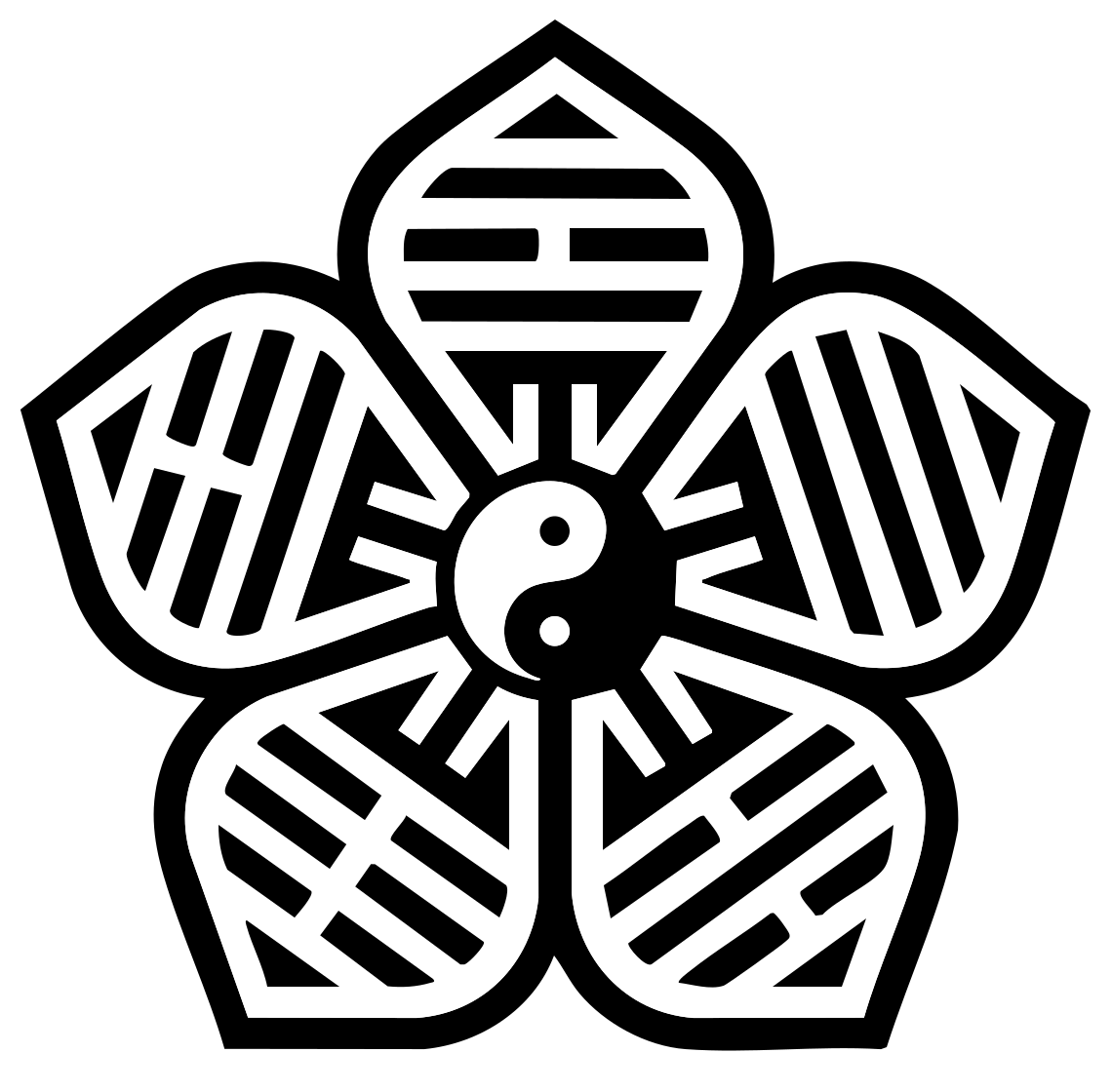
Now what happens when we introduce another line, to create a tie breaker effect? When three lines are drawn together, you get eight possibilities. This becomes the eight-trigram system, called the Ba Gua. The eight trigrams were also given names in nature: Earth, Mountain, Water, Wind, Thunder, Fire, Lake, and Heaven.
From Trigrams to Hexagrams
This is where the I Ching starts feeling almost magical. Chinese thought asks: what happens if we do not just study these forces one by one, but watch them interact? What if Thunder is placed below Water? What if Fire sits above Lake? What if Earth supports Heaven, or Mountain presses against Wind? The answer is the hexagram system. Put one trigram on top of another, and you get a hexagram: six lines total, one trigram below and one above. Eight possibilities below times eight possibilities above gives us the 64 hexagram system that is the basis of the I Ching.
Sixty-Four Living Situations
And that is one of the great insights of the I Ching: it treats life as a set of 64 patterned situations, or 64 stories of interaction. Not 64 random fortunes. Sixty-four living situations. Conflict. Waiting. Nourishment. Return. Family. Excess. Breakthrough. Exhaustion. Joy. Inner truth. Not-yet-complete. These are not abstract categories. They are recognizable human experiences.
Why the Eight Trigrams Matter
The trigrams are not just symbols; they are like archetypal forces. In one source, the lower trigram is described as an inner, foundational, or subjective force, while the upper trigram can be read as outer, objective, or situational. In other words, the bottom can describe what is moving within you, and the top can describe what is moving around you.
That means a hexagram can feel surprisingly personal. You are not just looking at “a symbol.” You are watching an inner world and an outer world meet. The I Ching is not only describing events, but the relationship between your state and your circumstances.
So What Is a Changing Line?
This is where the I Ching really becomes a book of changes, not just a book of symbols.
Every hexagram has six lines. A line can be either solid or broken. When you do a reading, one or more of those lines may be marked as a changing line. That simply means this part of the situation is moving. It is not staying the way it is. It is turning into something else.
A Concrete Example: From Hexagram 1 to Hexagram 44
A very simple way to understand this is to start with Hex 1 (The Creative), which is made of six solid lines. This hexagram is often associated with pure creative force, strong energy, and forward movement.
Now imagine we change just one line: line 1, the line at the very bottom. It starts as a solid line, and we change it into a broken line. That new shape is Hex 44 (Coming to Meet).
So with just one line changing, we move from one hexagram to another. And when that happens, we move from one story to another, one mood to another, one teaching to another.
Why One Line Changes Everything
That is the heart of the I Ching.
It is showing that life does not stay frozen in one pattern. A situation may begin with the energy of Hexagram 1, but once one line changes, the meaning shifts. The I Ching gives space to that change and describes what it means for each time a specific line changes. So the wisdom is not just “here is your situation.” It is also “here is the part of the situation that is transforming.”
And this works both ways. A line can change from solid to broken, or from broken to solid. Each change creates a different relationship between hexagrams, and each one has its own meaning.
A Web of Sixty-Four Hexagrams
Because a hexagram has six lines, and each line can change one at a time, every hexagram is directly connected to six other hexagrams. You can think of it like a network of direct paths. From any one hexagram, there are six immediate directions change can take, depending on which line moves.
That makes the I Ching feel much more alive. It is not just 64 separate symbols sitting still. It is 64 living situations, each linked to each other through change. Every hexagram is part of a web of movement.
Reading the Direction of Change
So a changing line means: this part of the situation is not stable. It is in motion. It is becoming something else. The first hexagram shows the present pattern. The changing line shows the active point of transformation. The second hexagram shows what the situation is tending toward if that movement continues. It is not a rigid prediction. It is more like the direction the energy is taking.
The Wisdom of Line Position
There is also a deep human logic to the line positions. The lines move from the bottom upward, and many interpreters read them as a kind of unfolding life cycle: beginning, emergence, transition, public action, authority or maturity, and finally culmination or excess. That is why line position matters so much. A change at the bottom line speaks to the beginning or foundation of a situation, while a change at the top line speaks to what happens when that situation has fully unfolded, reached its peak, or is about to turn into something else.
So a changing line is really the I Ching’s way of saying: this is the place where the story is shifting, and here is the significance of the meaning of that shift.
Why Changing Lines Matter Spiritually
Changing lines are one reason the I Ching can feel deeply spiritual without becoming preachy. They remind us that no situation is frozen. A hard season can soften. A beautiful moment can become unstable. A relationship can turn. A belief can open. A fear can loosen. A new life can begin inside an old one.
Spiritually, that is so powerful. It teaches humility, patience, and timing. It also teaches compassion, because if everything is changing, then people are not fixed either. The version of someone you are fighting with today may not be the version you meet tomorrow. That is one reason this book can help people connect. It encourages us to see one another as processes, not labels.
Plum Blossom and Other Living Methods
Over the centuries, many methods grew around the I Ching. One later stream is often called Plum Blossom Numerology. In broad terms, it is a way of generating trigrams and a changing line through number patterns, then reading the result as a living symbolic snapshot of a moment.
That matters because it shows how alive the tradition is. The I Ching is not one frozen technique. It is a symbolic language that later schools continued to explore. Plum Blossom is not the same thing as the earliest Zhou-period use of the text, but it is one of the ways later practitioners extended the system into a more intuitive and numerological practice.
What Is a Birth Hexagram?
A birth hexagram is an interpretive practice that links your birth time, season, or astrological correspondences to a hexagram pattern. Using Plum Blossom Numerology, it offers a symbolic snapshot of the energies and hexagrams present at the time of your birth.
A birth hexagram is not “who you are forever.” It is more like a symbolic picture of the atmosphere you were born into, a way of reflecting on temperament, timing, and the deeper themes woven through your life. For this reason the study of one’s birth hexagram can feel connective, illuminating, and deeply personal.
The Three-Part Reading
A birth hexagram reading is made up of three parts: a starting hexagram, one changing line, and the resulting hexagram. Together, these form a kind of spiritual cycle that walks with you through life. They can speak to who you are at the beginning of your journey and who you are slowly growing into over time. They can also reflect your inner process, your way of making decisions, your natural rhythm, and the movement of your energy through different stages of life.
What a Birth Hexagram Is Not
These symbols are not meant to box you in or define you once and for all. We all carry aspects of all 64 hexagrams within us. Your birth hexagrams are better understood as guiding symbols of your innermost nature, and as a beautiful point of entry into the living wisdom of the I Ching.
Love and the I Ching
At the end of the day, the I Ching has lasted and remained deeply relevant for over 3,000 years because it speaks to an everlasting truth. The I Ching provides an incredibly unique form of guidance and depth of meaning.
It gives us a way to flow with the movement of life and embrace those changes without fearing or fighting them.
It gives us a way to understand ourselves and the many connective tissues in relationships.
It gives us a way to see that every ending contains a beginning, and every fixed identity is already shifting.
So what is the I Ching?
It is an ancient Chinese philosophy that holds the spiritual language of change. It is a way of understanding how our inner world meets the outer world. It is the conversation people need in order to find each other again.
And still, even this falls short. Perhaps the Tao says it best: the Way that can be spoken is not the eternal Way.