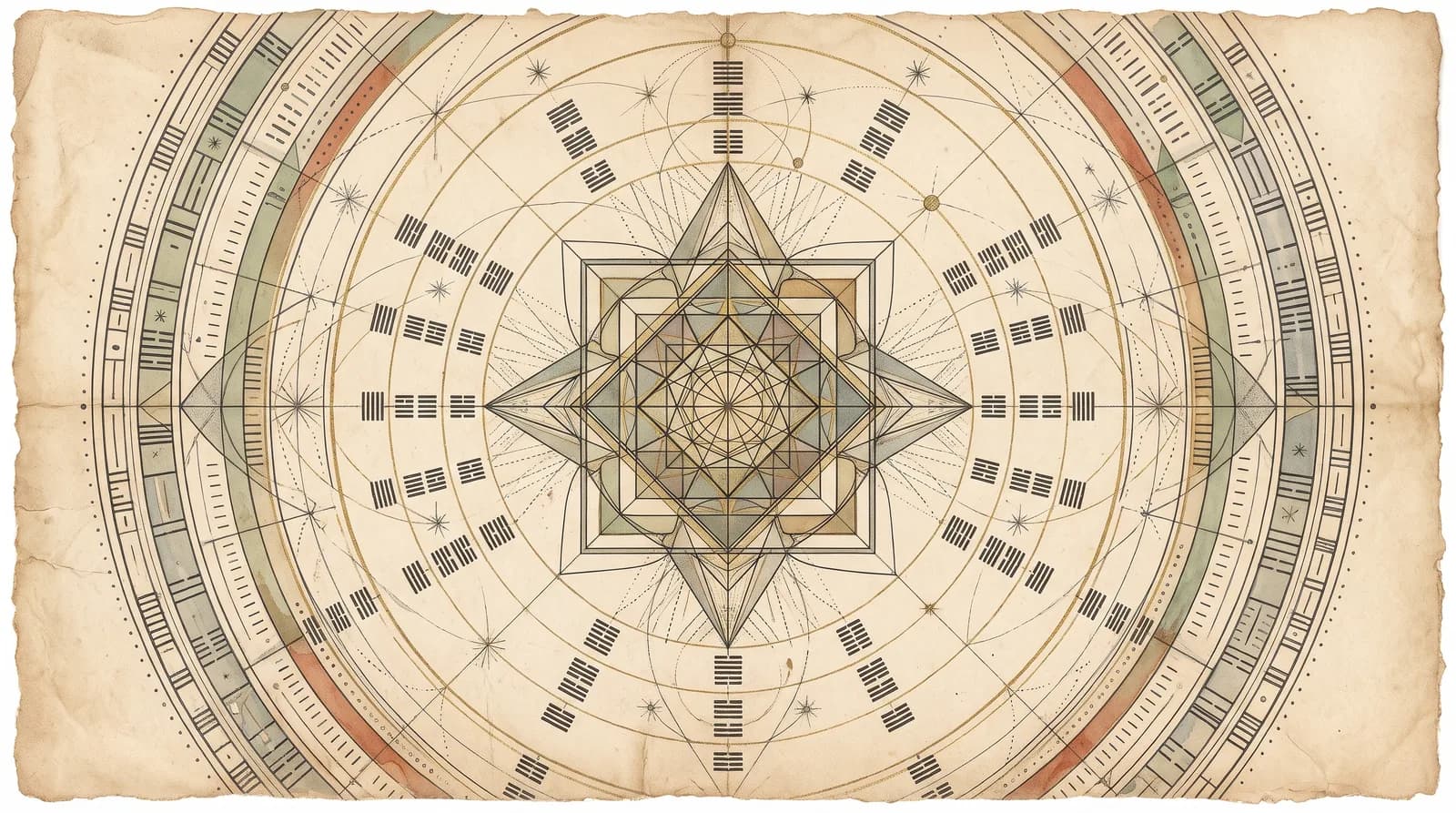
Two people, one map. That is the whole idea, and the first question anyone asks when they see theirs is the same one: how good is it? HexWave answers with a name rather than a number. If you have ever wondered how Chinese zodiac compatibility is actually calculated, or what the I Ching (also spelled Yijing or I-Ching) could possibly have to say about two birth dates, this post is the derivation, in full.
I am writing it because the pages that rank for these questions are mostly calculators with four hundred words wrapped around them. Two dates go in, a percentage comes out, and nothing on the page says where the percentage came from. HexWave computes something in the same family, so I would rather show the working.
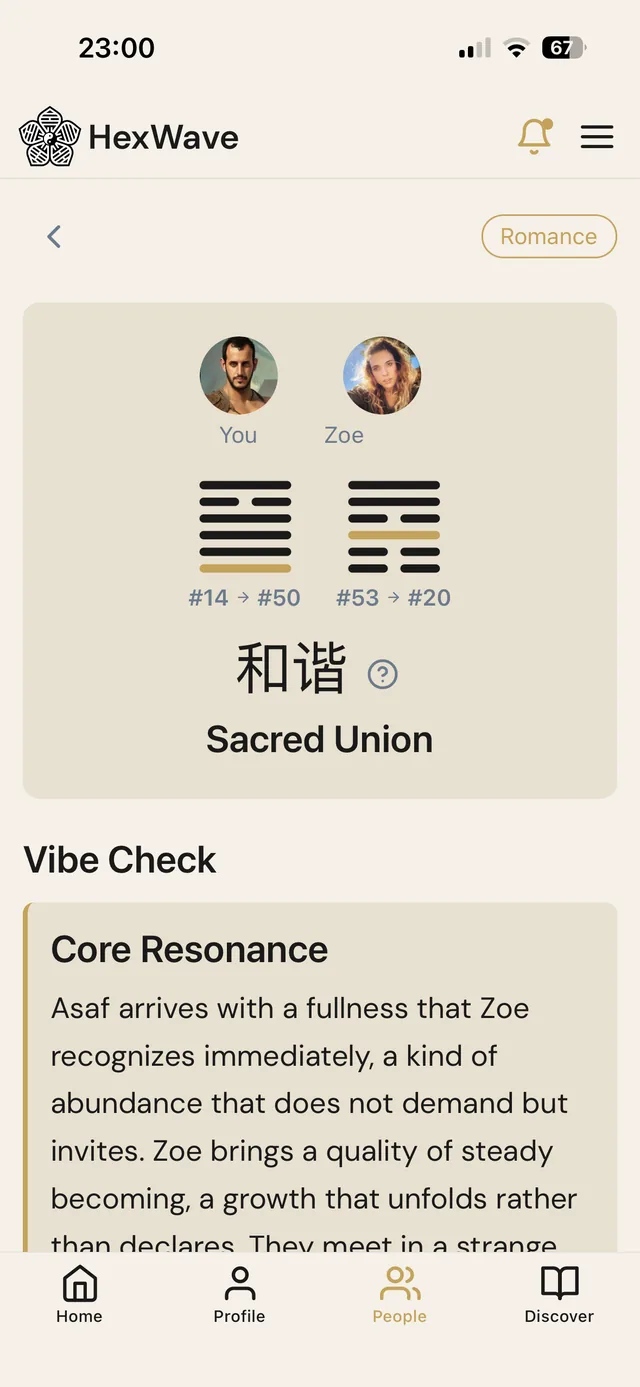
What a mutual map actually is
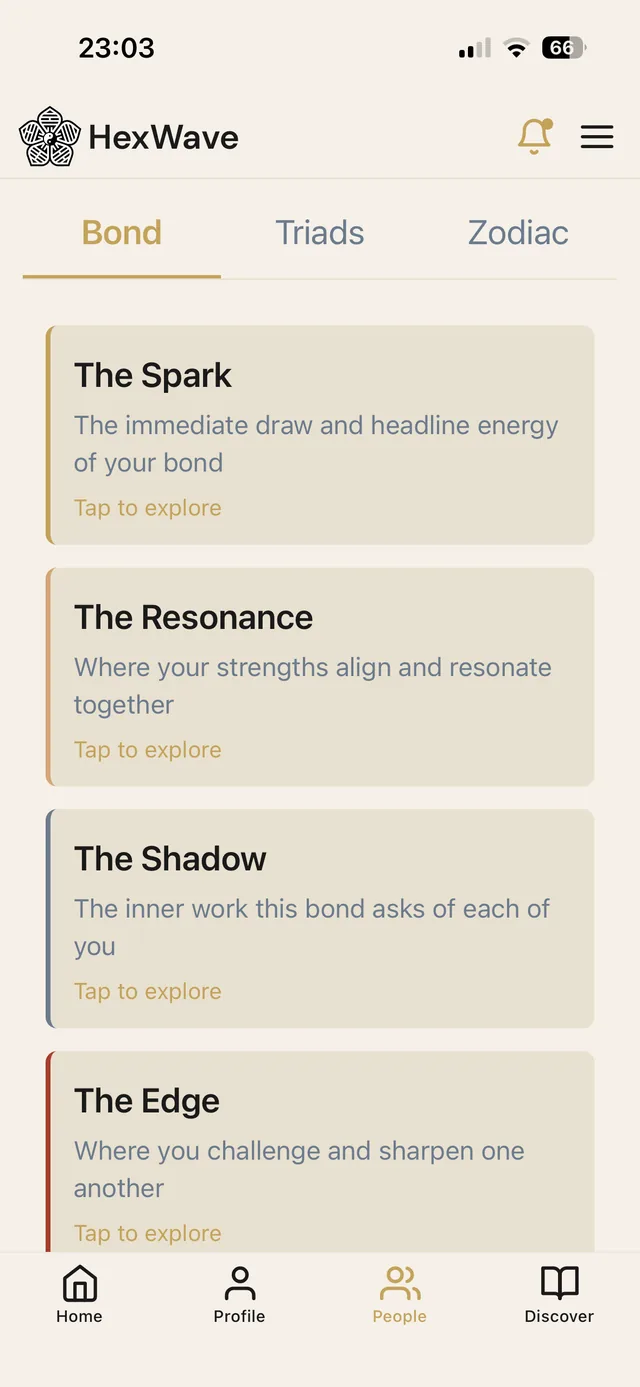
A mutual map reads the relationship itself, treated as a third thing with a shape of its own, rather than passing a verdict on either person. It looks at the same two birth charts through five different lenses, each asking a different question of the same pair, and the mutual maps primer walks through all five properly. I will not re-explain them here, and a couples counselor walks one pair through the lenses. This post is about the other half of the map: the single tier name that sits above the five lenses and describes the overall texture of the connection.
How is I Ching compatibility calculated?
Three layers, computed independently and then combined. Every input is a birth date. Nothing is sampled, nothing is drawn at random, and the same two dates give the same answer forever.
Layer one: how the two hexagrams meet
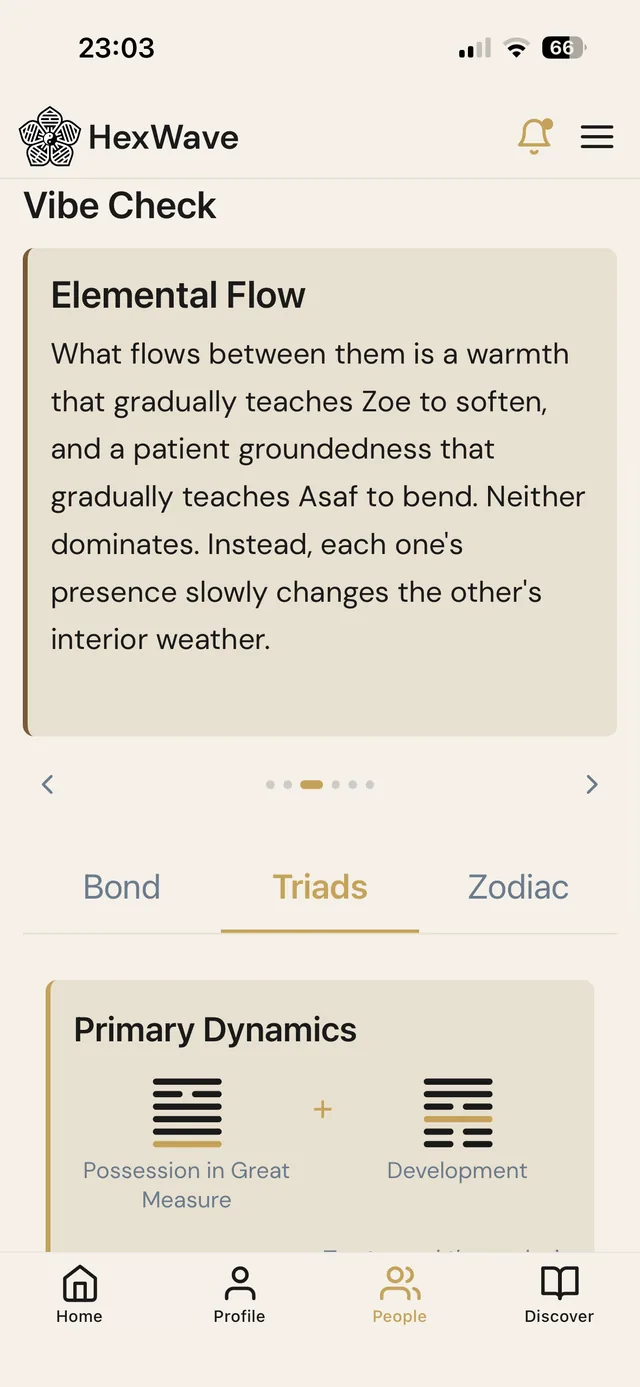
Each person has a Birth Hexagram Triad: a primary hexagram, a changing line, and a resultant hexagram. The first layer compares the two primary hexagrams three ways. It counts how many of the six lines match position by position. It looks for shared trigrams, the three line halves each hexagram is built from, and gives extra credit when a whole trigram matches rather than three lines scattered across the figure, because a complete trigram is a named thing with its own element and family role. Then it checks whether the two figures share a nuclear hexagram, the shape hidden inside lines two through five, which is the closest thing this system has to a family resemblance between two patterns that look nothing alike. Two people who both carry Hex 22 (Grace) score loudly here for obvious reasons. Two people related only by nuclear kinship score quietly, but they do score.
Layer two: how the two birth triads interlock
The second layer stops asking who you are and starts asking where you are going. The strongest reading in the whole model is a mutual arc crossing: your resultant hexagram is their primary, and their resultant is yours. Each of you is already standing where the other is headed. When only one side of that crossing holds, the layer treats it as friction rather than half a win, because a one way arc is one person waiting for the other to catch up. Underneath that it rewards a shared destination, a shared changing line, complementary lines that sum across the figure, trigrams held in common across all four hexagrams in the two triads, and the classical relationships between the two resultants.
Layer three: how the zodiac pillars relate
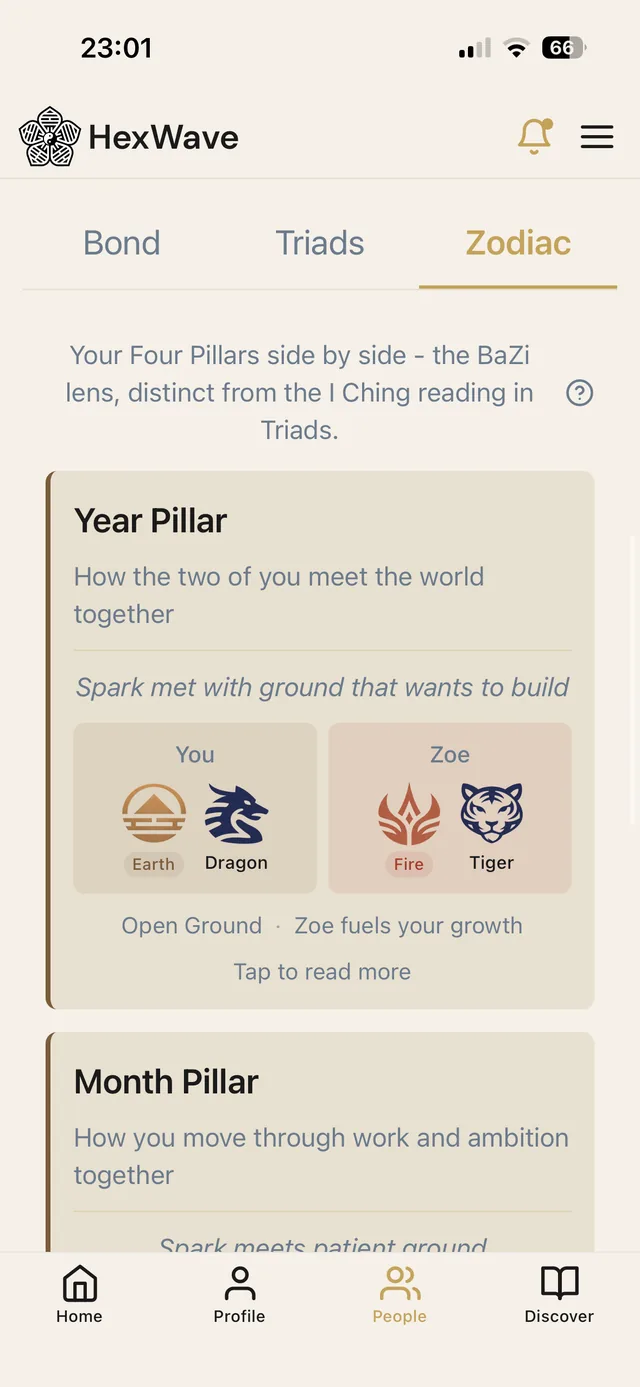
This is the layer people mean when they ask about animal signs. Your birth date produces not one animal but a small chart of pillars, each carrying an animal and an element with a yin or yang polarity: a year pillar, a month pillar and a day pillar. HexWave compares all three, animal to animal and element to element. That is worth saying out loud, because almost every compatibility page online compares year animals only, which makes everyone born in the same year read as identical.
Two things separate this layer from the usual treatment.
The first is that it counts every classical relation a pair has instead of only the loudest. The traditional relations are trine, six harmony, clash, punishment, harm, break and self punishment, and a single animal pair can carry several at once. Take the Snake and the Monkey. They are a six harmony pair, one of the six classical unions. They are also a punishment pair. They are also a break pair. All three at the same time, in the same two animals. Look the pair up and you will find sources calling it a wonderful match and sources calling it a clash, because each picked one relation and threw the rest away. Counting all three lets them net out, and the pair reads as harmony with real friction in it rather than as a blessing or a curse. That is the more honest answer and, I think, the more useful one.
The second is the element cycle running between the stems. Elements produce one another, control one another, or sit neutral, and a controlling pair normally reads as pressure. There is a classical exception: where the controller is yang and the controlled is yin, the pair forms a heavenly stem union, and traditional practice reads that as a bond rather than a conflict. Getting the exception exactly right matters, because the loose version of the rule fires on twice as many stem pairs and quietly doubles how often the model reports a union.
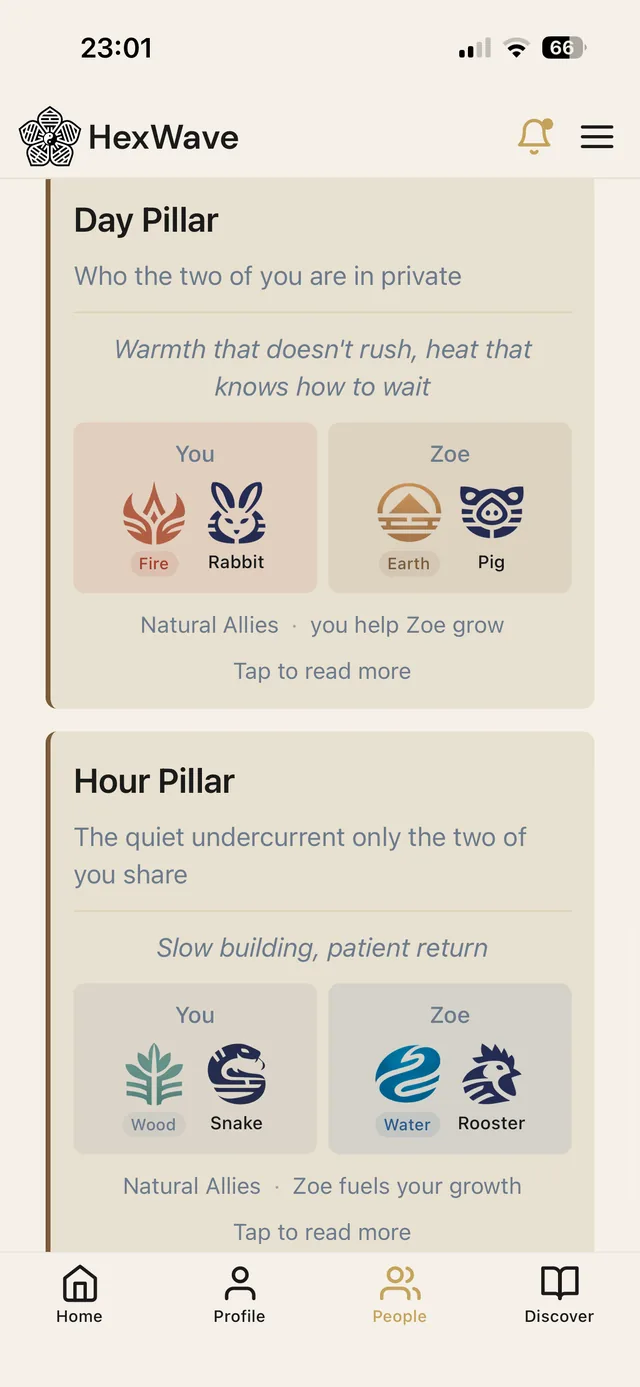
The hour pillar is left out on purpose. It exists only when a birth time and place are known, and it would have to be known on both sides. Including it would mean asking one question of the couples with complete records and a different question of everyone else. The hour pillar still appears in the Zodiac tab, where it describes you rather than scoring a pair. For the tour of the animals and elements themselves, the Chinese zodiac primer is the place to start.
Why does Chinese zodiac compatibility read differently for friends than for partners?
Same three layers, same inputs, different weighting, and the difference lives almost entirely in the pillars.
Romance leads on the day pillar. In classical marriage practice the day pillar is the spouse palace, the seat of the self and the partner, so a romance reading that treated it as one third of the zodiac layer would be ignoring the tradition it borrowed the pillars from in the first place. The month pillar sits second and the year pillar third.
Friendship weighs the three pillars equally, and it does so because there is nothing to lean on. Marriage compatibility is a real classical method with centuries behind it. Peer friendship is not, the nearest classical analogue is a stretch, and an earlier version of HexWave carried a friendship weighting that implied a doctrine which does not exist. When the tradition is silent, a flat prior is the honest answer. It is not a cosmetic choice either: against the old weighting it moves the friendship tier for a noticeable share of pairs.
So the same two people can read as an easy friendship and a demanding romance, or the other way around, with no contradiction anywhere. The layers did not change. The question did.
From layers to a name: the equation
Each layer produces a raw score, each raw score is normalised onto a common range, and the three are averaged with their weights. That weighted average passes through a shifted logistic curve.
The curve does one job: it turns a raw sum into a bell. Pairs near the middle of the range get squeezed together, so most connections land in the common middle of the ladder, and pairs out at the edges get pulled apart, so the extremes stay genuinely rare. That is a design decision, not something the data happened to do. A model that hands out its top tier freely is not measuring anything.
How rare is each tier?
Six rungs, named separately for friendship and for romance. Here is what the model actually produces for pairs where both birth times are known.
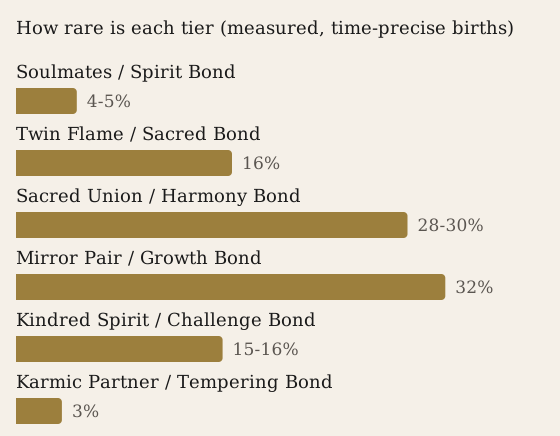
The top rung lands at 4 to 5 percent, the second at about 16, the two middle rungs at roughly 29 and 32, the fifth at 15 to 16, and the last at about 3. Each one is a range because friendship and romance weight the same three layers differently, so the two ladders do not cut the population in quite the same place. Those figures were measured over tens of thousands of simulated pairs, not over anybody's users. I do not run distribution studies on real relationships.
One caveat, and it is a real one. Date only births are coarser than time precise ones. Without a birth time the engine works from a noon default, and a fixed hour collapses the hexagram side of the calculation onto eight primary figures instead of sixty four, so roughly 1 in 8 date only pairs share a hexagram outright. Date only maps skew a little toward the top of the ladder because of it. They are not wrong, they are lower resolution, and they sharpen the moment a birth time arrives.
Does the I Ching really work?
That is the most searched question about the book, and this post can only answer the narrow version: what this calculation is, and what it is not.
It is deterministic. The same two birth dates always produce the same tier, on my machine, on your phone, today and in ten years. There is nothing to reroll and no better mood to catch it in.
It is symmetric. The reading of you against them is the reading of them against you, by construction. Both people open the same map and see the same tier name. A model where one person quietly outranked the other would be a worse idea.
It is not predictive. Nothing here forecasts whether a relationship lasts, and I would not believe it if it said otherwise. It describes a shape.
It is not punitive, which is why HexWave shows a name and never the number underneath it. A name is descriptive: Growth Bond says what kind of work the connection asks for. A number invites ranking, and ranking the people you love is a bad thing to hand anybody on a phone screen. The number exists inside the engine because the arithmetic needs it. It does not exist on the screen because you do not.
Whether the book itself works is a much older argument than this post, and I have written my honest answer to it elsewhere. What I can defend is the arithmetic. It is reproducible, it is symmetric, and every step of it is written above.