The I Ching does not predict whether a relationship will last. It describes the pattern two people are living, and where that pattern can move. Couples counselor Zoe Eliyahu, our first guest writer, explains how she reads it alongside her practice, with one worked pair of hexagrams.
An argument begins with dishes in the sink or an unanswered message. Minutes later, the couple is no longer discussing either. One person feels unseen; the other feels criticized. Neither notices the pattern forming between them, because defending ourselves against our partner can be just as isolating as attacking them. In effect, both actions momentarily treat the partnership as a battlefield, and that is going to filter down and result in a fight rather than healthy communication, or even a healthy argument. Lord knows, sometimes we need to argue with our partners!
In my work with couples, I return to one question: What is happening in the space between two people? The I Ching, the ancient Chinese Book of Changes, can help us see familiar patterns differently.
What Is the I Ching, and What Does It Have to Do with Relationships?
The I Ching is one of the oldest philosophical and divinatory texts still studied today, with roots stretching back approximately three thousand years. At its heart is a simple idea: everything alive changes. When something stops moving altogether, it is essentially dead.
Relationships are living, breathing organisms as well. I see relationships as a three-part system: there is the "you," there is the "me," and there is the "us." With such a complex dynamic, you can bet relationships are in constant flux too.
The I Ching comprises 64 hexagrams, or symbols, each formed from six solid or broken lines. Each represents recognizable life situations and human states of being: conflict (Hexagram 6), waiting (Hexagram 5), nourishment (Hexagram 27), development (Hexagram 53), and fellowship (Hexagram 13), to name a few. Instead of asking only, "Are we compatible?" we might ask, "What pattern are we living together, and how could we meet it differently?"
Yin and Yang: Not Strong Versus Weak
The lines are associated with yin (traditionally represented by black and a broken line, ⚋) and yang (white and a solid line, ⚊). Yang evokes initiative; yin evokes receptivity. These are not personality types or gender roles. We all need firmness and flexibility, and we all carry both yin and yang within us.
Imagine one partner wanting to discuss an argument immediately while the other needs quiet first. Wanting to talk does not mean loving more; needing space does not mean caring less. Trouble begins when each interprets the other's response as rejection. Neither response is inherently wrong.
Seeing the Pattern Instead of Blaming the Person
In CBT-based couples counseling, we examine how thoughts, feelings, and behavior interact. Consider the thought, "They are silent because they do not care." That is an interpretation, not a fact. It triggers hurt, followed by criticism. Criticism produces withdrawal, which seems to confirm the original belief. A cycle develops even when neither partner intends it.
The I Ching offers a second, symbolic vocabulary for noticing such cycles. Without replacing communication skills or accountability, it can interrupt the question "Who started this?" and make room for "What are we creating together?" A new question can open a new way of having an old conversation.
Changing Lines: Where Can the Relationship Move?
When we interpret how each partner's birth hexagrams interact with one another, the inner workings of their relationship dynamics can begin to come into focus.
In the I Ching, when a line shifts from solid to broken, or the reverse, another hexagram appears. Together, the original hexagram, the changing line, and the resulting hexagram suggest a present pattern, a point of change, and a possible direction.
Within a relationship, the practical question is: where could one response change? Perhaps one person can ask for closeness without criticism. Perhaps the other can say, "I need ten minutes, but I will come back," rather than retreating into silence. A small shift can change what happens next.
Can the I Ching Tell You Whether You Are Compatible?
Question readings differ from birth-based maps. With traditional coin casting, you might explore: "What should I understand about our distance?" A later method, Plum Blossom numerology, derives a birth hexagram from birth information; HexWave reads it as a Birth Hexagram Triad: a Primary Hexagram, Changing Line, and Resultant Hexagram.
HexWave uses this birth-based approach. Its Mutual Maps place two triads side by side through five lenses: Spark, Resonance, Shadow, Edge, and Oracle's Counsel.
These invite reflection on attraction, harmony, what partners reveal in each other, and where friction offers growth. They offer spiritual insight into the inner workings of relationship dynamics, creating a space to read, reflect, and explore how the unique ways two people come together might teach them to become better partners to each other and more loving toward themselves.
The Mutual Maps: Me and You... How Do Our Hexagrams Interact?
A birth hexagram is a symbolic representation derived from the moment you were born. Using your birth date, sharpened by the time and place when you have them, HexWave calculates your personal Birth Hexagram Triad, offering insight into your underlying nature, your areas of growth, and the direction of your personal development.
When two people's triads are placed alongside each other, something interesting happens. We can begin to explore not only who each person is individually, but what emerges when their two patterns meet.
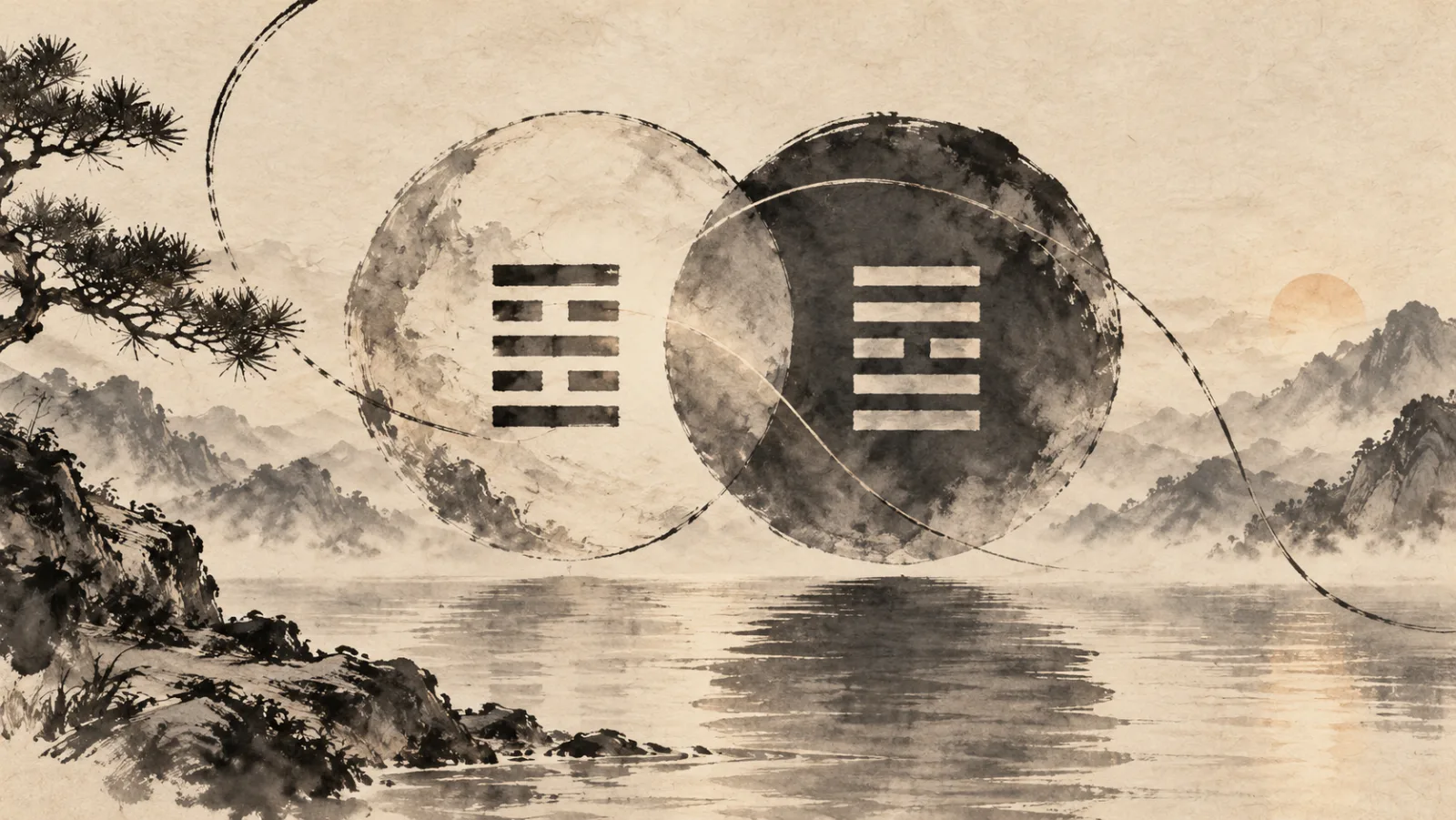
Consider an illustrative example of two partners. One has Hexagram 49, Revolution as their Primary Hexagram, while the other has Hexagram 50, The Cauldron.
Revolution represents the need to break with what no longer serves us. The Cauldron speaks of transformation through nourishment, refinement, and the careful cultivation of something valuable.
Imagine how these two might experience conflict. One partner wants to change everything immediately, while the other wants to preserve what is meaningful and transform it gradually. Both may desire growth, yet their approaches can feel threatening to one another.
Through HexWave's five lenses, we might explore what initially draws these two together, where they naturally resonate, what insecurities they reveal in each other, and how their differences might become opportunities for growth.
The Edge lens is particularly interesting here. What one partner experiences as necessary change, the other might experience as disruption. Yet neither perspective needs to be wrong. Perhaps the invitation is to discover how transformation and continuity can coexist.
This is an illustrative interpretation rather than an actual calculated Mutual Map, but it shows how two hexagrams can open an entirely different conversation about a relationship.
Curious about your own relationship? Enter your birth details and your partner's into HexWave, explore your Mutual Map, and see which insights truly hit home.
When two people are willing to look at themselves, the Book of Changes offers a reminder: we are not only who we were yesterday, and our relationship need not remain exactly as it is today. The question may be less about finding a perfect match and more about learning to meet each other in the space most conducive to both partners' growth.
For an I Ching reading or couples counseling, explore the services at The Space Between, or discover your birth triad through HexWave.