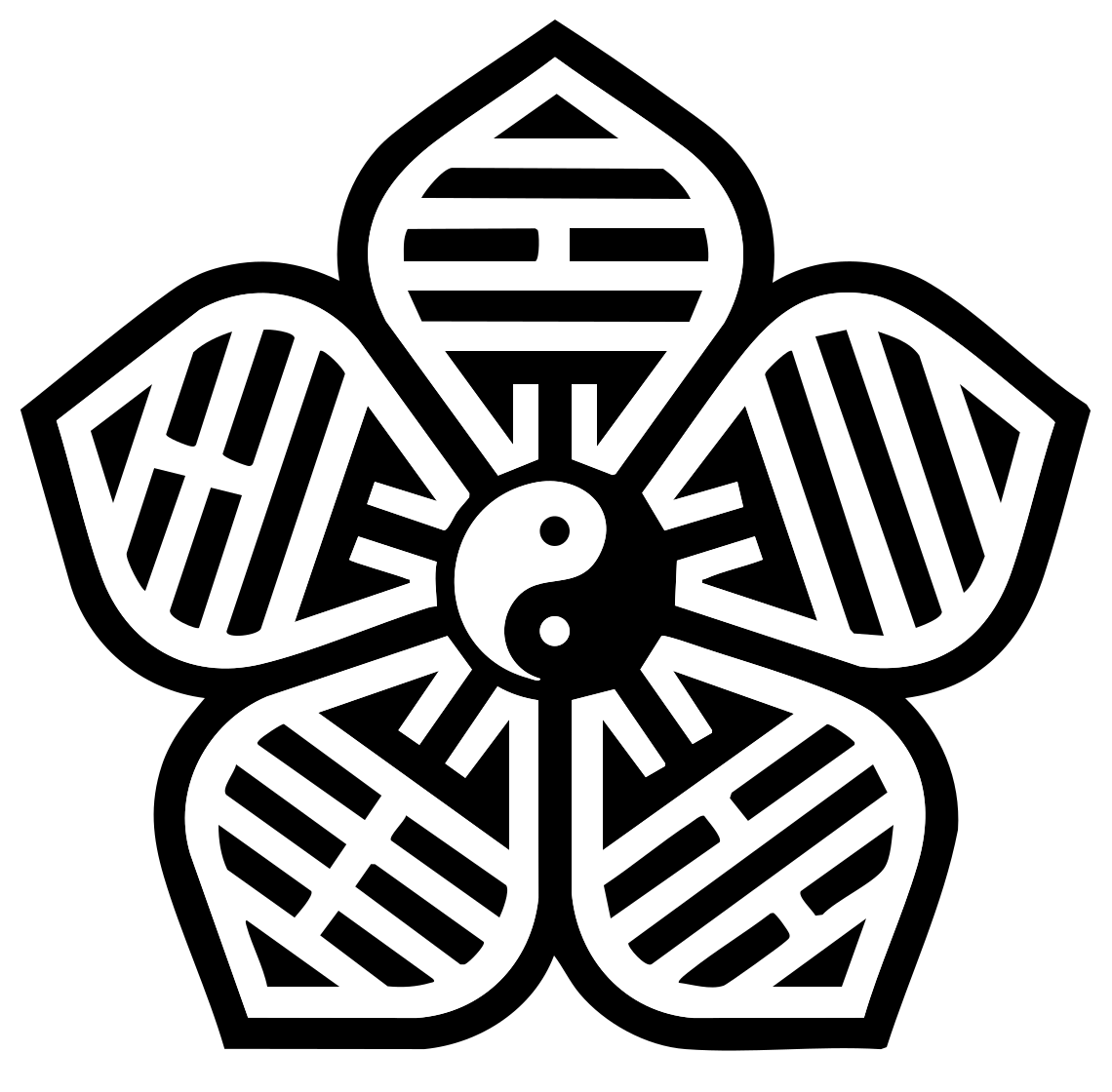
Trigram breakdown
Upper · Heaven · 乾
Unbroken yang. The weather of pure initiative, light that carries forward.
Lower · Water · 坎
Yang held inside two yins. The hidden current; danger and depth at once.
Judgment
'Conflict' arises when inner strength meets an uncertain, shifting foundation. Heaven drives upward and outward with clarity and force, while Water below is cunning, changeable, and moves sideways. The structural tension is between the drive to assert and the conditions that resist or undercut that assertion. This hexagram does not counsel avoidance of conflict, but warns that pressing forward with full force against such a slippery, deep opposition will not resolve matters - only a partial, carefully bounded engagement can lead anywhere productive.
Image
Heaven above pulls upward while Water below seeks the lowest ground, two forces oriented in fundamentally opposite directions. When a river tries to flow uphill or the sky tries to press the river flat, neither wins and both distort. The image teaches that when the basic orientations of two parties are incompatible, the solution is not to push harder but to find a point of separation or arbitration that lets each element return to its proper course.
Essence
Character
This person notices what is unfair or does not add up, and says so even when the room would rather move on. Questions others avoid come out plainly. That honesty is a real gift. It protects people who cannot speak for themselves, and it keeps small wrongs from hardening into habits. Under pressure they stay exact and steady. The cost shows up at the finish line. They keep arguing after the matter is settled, or take up fights that were never theirs. Being right turns into stubbornness. The turn is small: asking what would actually settle this, and accepting a fair partial answer instead of a total win.
With other people
Among others, this person is the one who names the problem first. Some people feel relieved by that. Others feel watched or cornered. They lead through clarity, not warmth, and people can grow guarded around them. What brings others back is a quiet habit: when they have made their case, they sometimes stop, say it was heard, and let the room breathe.
Heaven over Water
Heaven's clear, upward insistence sits on top of Water's deep, sideways doubt, so a firm public stance is fed by a private, restless sense that something is off.
The six lines
Hexagram 6 Line 1 (6.1)
A yin line at the base of the hexagram, just at the start of a conflict - the situation is new and the grievance is small. Letting the matter go now is possible and costs little, while pressing it forward will magnify the trouble far beyond its original scale.
Hexagram 6 Line 2 (6.2)
A yang line in the second position carries real strength but lacks the authority to press a claim without drawing disproportionate opposition. Retreating from direct confrontation here is not weakness but a recognition that the opposing force is too formidable to overcome, and withdrawing protects what one has already secured.
Hexagram 6 Line 3 (6.3)
A yin line in the third position, caught in the transition zone between positions, signals that the real ground of safety lies in what has already been established, not in new claims. Clinging to old merits and staying within known boundaries prevents the kind of overreach that turns a manageable dispute into a disaster.
Hexagram 6 Line 4 (6.4)
A yang line in the fourth position has enough strength to press a conflict further, but the structural position makes forward movement unstable. Recognizing this, returning to one's foundational position and reorienting toward a calmer path, brings a kind of peace that force would never have achieved.
Hexagram 6 Line 5 (6.5)
The ruler's line, yang in the fifth position, is the strongest and most legitimate site of authority in this hexagram. Conflict brought before this position finds resolution through clarity and impartiality - the outcome is favorable precisely because the adjudicating force here is both capable and centered.
Hexagram 6 Line 6 (6.6)
A yang line at the very top of 'Conflict' represents someone who has pursued a dispute all the way to its conclusion and won - yet the victory is hollow, because anything gained through protracted conflict can be stripped away again before it is even consolidated. The belt awarded at the top of this hexagram will be taken back three times before the day is done.
Keywords:
- dispute
- obstruction
- assertion
- mediation
- restraint
Relationships
Opposite
Darkening of the Light
The hexagram with every line flipped - its energetic mirror.
Inverse
Waiting
The hexagram read from the top down - its reverse-perspective.
Reverse
Waiting
The hexagram with upper and lower trigrams swapped - the inside turned out.
Nuclear
The Family
The hexagram built from the inner four lines (2-3-4 below, 3-4-5 above) - its inner architecture.
Family
The eight-hexagram palace it belongs to - kin generated by sequential line changes from a pure-trigram source.
Gate 6 in Human Design
In Human Design, Hexagram 6, Conflict, is Gate 6, with the same six lines. It sits in the Solar Plexus Center, and its one channel connects it to Gate 59 in the Sacral Center. How to read your gates in the I Ching
The reading goes further down
What you have read here is the shape of Hexagram 6, 'Conflict'.
Underneath it sit four more: the mechanic that drives it, the shadows it casts, the way through them, and the tension between Heaven and Water that never quite settles.
And if this hexagram appeared in your Birth Hexagram Triad, one of its six lines is changing. That line is your growth edge, named out loud.