About ten years ago a random Facebook post showed me my first Human Design chart. Most charts are a web of colored channels. Mine had exactly one: the channel between Gate 10 and Gate 20. I was fascinated, and I wanted to know what Gate 10 and Gate 20 actually were. That question led me somewhere I did not expect. Every gate on the bodygraph is a hexagram, and the book they come from is the I Ching. It has been growing with me ever since.
This post is for anyone who knows their gates and has never opened the book behind them.
What are gates in Human Design?
Every gate in Human Design is one of the 64 hexagrams of the I Ching, matched number for number from Gate 1 to Gate 64, and each gate carries its hexagram's six lines (384 lines in all). Human Design arranges the 64 hexagrams around a wheel, the Rave Mandala, and the planets at the moment you were born land on some of them, and so do the planets from 88 degrees of the Sun's path earlier, about 88 to 89 days before birth. Those are your activated gates. When two gates at either end of a channel are both activated, the channel is defined.
So when your chart says you have Gate 10, it is pointing at Hexagram 10. Ra Uru Hu wrote his own gate and line descriptions in the Rave I'Ching (often written Rave I Ching), and most Human Design apps use readings in that tradition. The I Ching itself is the older layer underneath, and it describes the same 64 figures with images that are about three thousand years old.
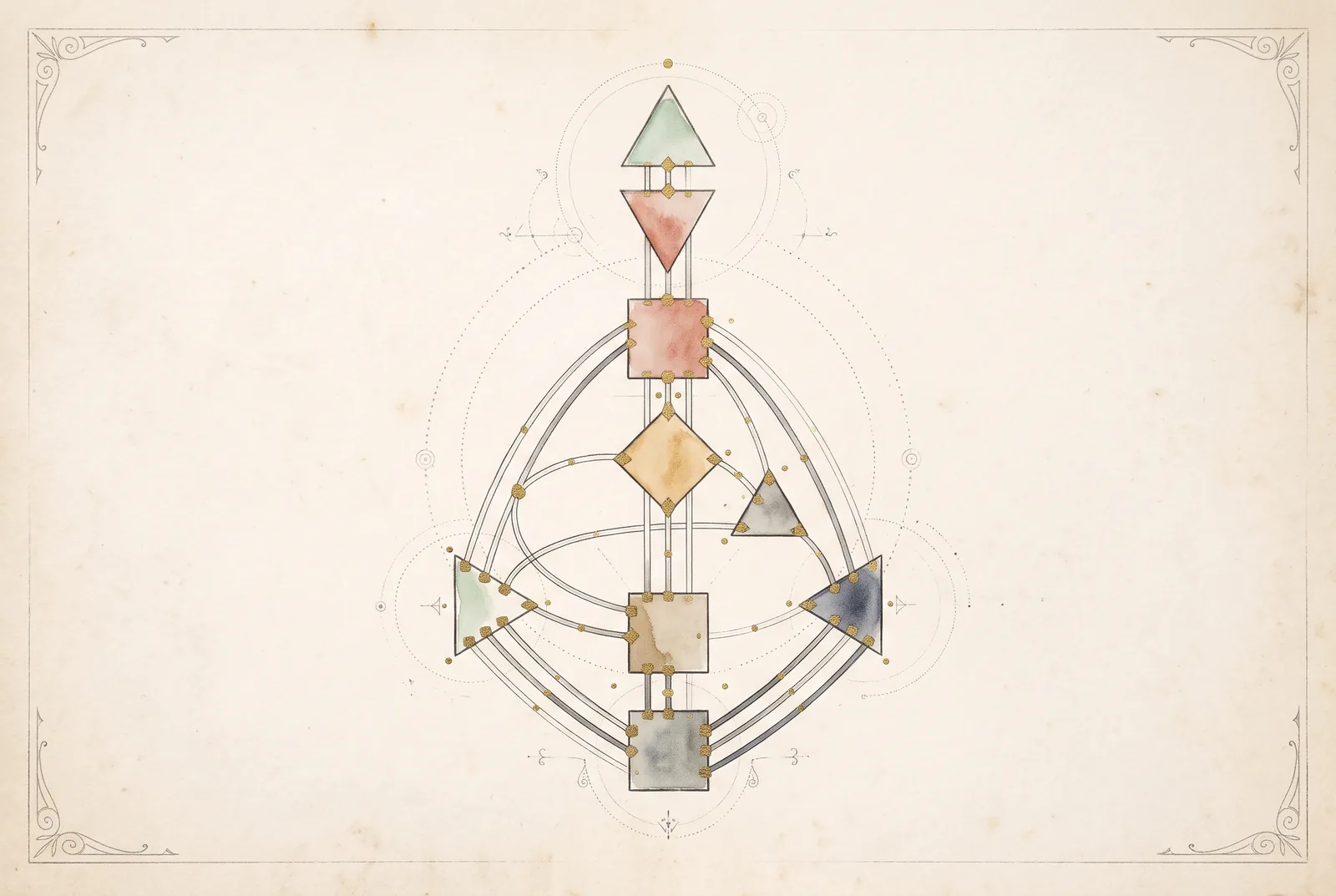
If you want the full map of how the two systems fit together, the wheel, the zodiac and where they part ways, we wrote it up in I Ching vs Human Design. This post is the personal version.
Channel 10-20: one channel, one voice
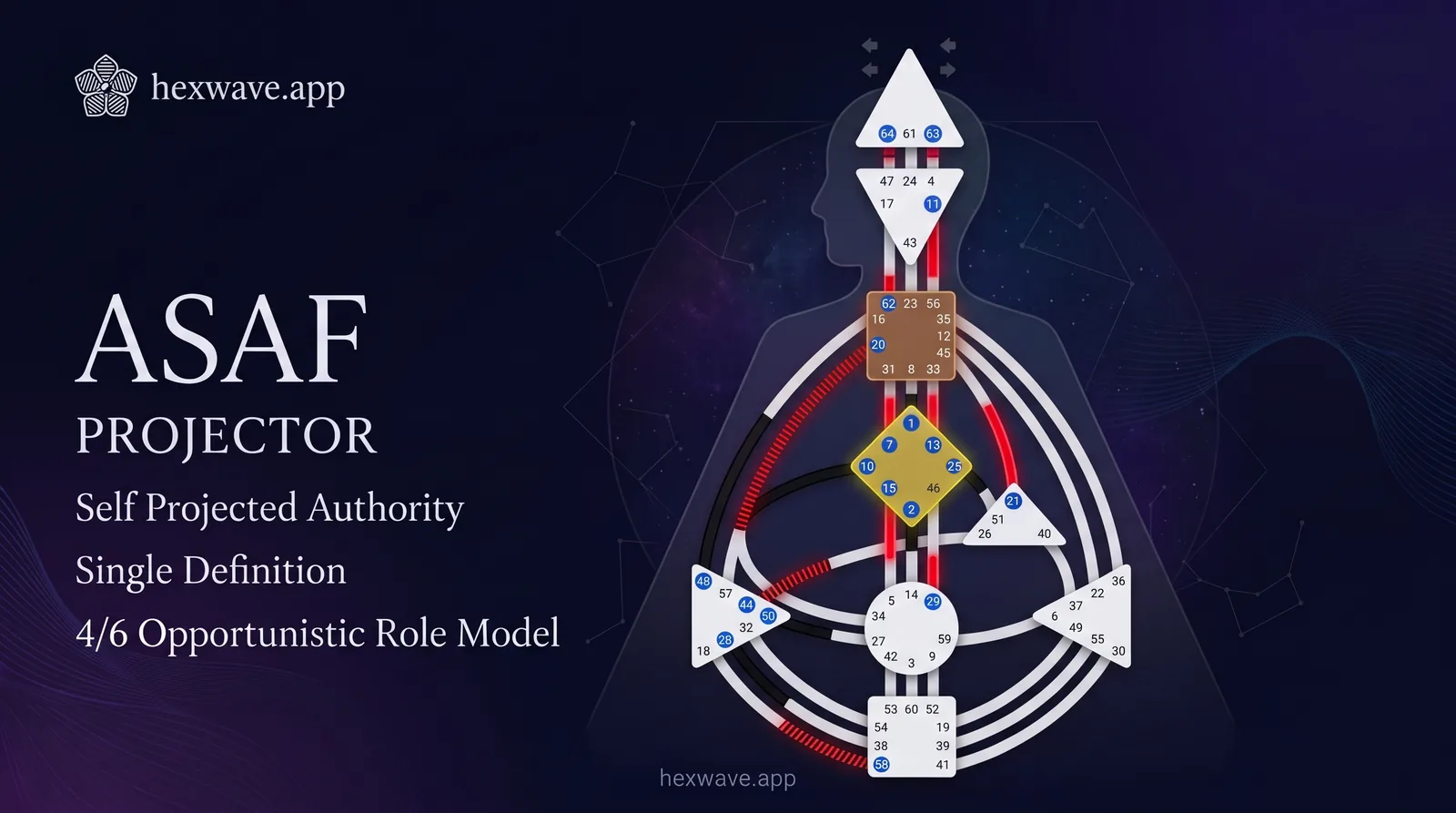
I am a Projector with Self-Projected Authority. The one channel in my chart, 10-20, is called the Channel of Awakening. It connects the G Center, where Human Design places identity and direction, to the Throat, where things are spoken into the world.
In practice that describes me well. I find out what is true for me by hearing myself say it, in the moment. My voice, sharing the now, is what guides me through life. Gate 10 on one side, Gate 20 on the other, and one road between them.
So I went to the I Ching and read both hexagrams.
Gate 10 and Hexagram 10: Treading
In Human Design, Gate 10 is the Gate of the Behavior of the Self. It is about loving yourself enough to behave as yourself: walking your own way, whatever the room expects.
The I Ching calls Hexagram 10 Treading. Its classic image is stepping on the tail of a tiger, and the tiger does not bite. On HexWave we put it this way: correct conduct is not about suppression but about calibrating your step to the actual ground beneath you. The trigrams are Heaven above and the Lake below: something light and open, moving carefully under something vast.
The two readings meet in one place. Both are about how you conduct yourself. But they come at it from different directions. The gate speaks from the inside out: be yourself, and that is the behavior. The hexagram speaks from the ground up: notice where you are standing, and step accordingly. Reading both, I understood my own Gate 10 better than from either one alone. Being myself is not the same as being careless. It is walking my own way with my eyes open.
Gate 20 and Hexagram 20: Contemplation
In Human Design, Gate 20 is the Gate of the Now. It is about awareness that becomes words in the present moment: recognizing what is here, and saying it.
The I Ching calls Hexagram 20 Contemplation. Its image is the Wind moving over the Earth, touching everything and seizing nothing, like a high tower from which the whole landscape becomes visible. One line from our reading stayed with me: it works best when you treat seeing as the first half of the job, and then say one plain thing aloud before you feel ready.
Here the two traditions almost finish each other's sentence. The gate says: speak in the now. The hexagram says: first see the whole view, then speak. For someone whose authority is their own voice, that is a useful order to remember.
Human Design and the I Ching: different frequencies
People sometimes ask me which one is right. I do not think that is the question. Human Design and the I Ching both carry a lot of knowledge, and I think of them as different frequencies of the same thing. Neither one makes the other wrong. I love both.
What the I Ching adds, for me, is its age. It describes the same 64 patterns in an older language of images: lakes, mountains, wind, a tiger's tail, a cauldron. When a gate description feels abstract, the hexagram often gives me a picture I can carry around.
Gate lines and profile lines
Every hexagram has six lines, counted from the bottom up, and every gate in Human Design has the same six lines. That is what the number after the dot means in a chart. My Personality Sun is at 1.4: Gate 1, line 4. My Design Sun is at 7.6: Gate 7, line 6.
Those two numbers are my profile. A 4/6 profile simply means the Personality Sun sits on a fourth line and the Design Sun on a sixth. The Earth always sits on the same line as its Sun (my Earths are at 2.4 and 13.6), so the Sun and the Earth give the same answer.
Which means you can read your profile lines in the I Ching too. My Sun line is Hexagram 1, line 4, and my Design Sun line is Hexagram 7, line 6.
A separate lens: your Birth Hexagram
HexWave asks a different question of the same birth date. Instead of placing planets on the wheel, it uses the Plum Blossom method, a classical way of turning a moment in time into a hexagram, and gives you three things: a Birth Hexagram (who you are), a Changing Line (your growth edge) and a Resultant Hexagram (who you are becoming).
Mine is Hexagram 14, Possession in Great Measure, with line 1 changing, which turns it into Hexagram 50, The Cauldron.
大有 Dà Yǒu
鼎 Dǐng
You can read more about the three parts in what a Birth Hexagram is, or see how HexWave calculates it.
I want to be careful here. This is not an explanation of my Human Design chart, and it does not map onto my channel. A Human Design chart is vast: which gates are active, from which planets, the colors, tones and arrows. One triad cannot stand for all of that, and it does not try to. It is another angle on the same person, and I find the two sit well side by side.
Three steps to read your own gates
You do not need to learn a new system to start. Three steps:
- List your gates. Open your chart in any Human Design app and write down the numbers of your activated gates. If your app shows them with a line, like 1.4, keep the line too.
- Open each hexagram. Gate N is Hexagram N, and all 64 hexagrams are on HexWave. Every page has the judgment, the image, a reading of the character, and all six lines, so a gate at 1.4 can go straight to line 4.
- Start with your channels. If you have a defined channel, read both of its hexagrams side by side, the way I read 10 and 20. That is where the two pictures start talking to each other.
All 64 Human Design gates and their hexagrams
Here are all 64 gates with the hexagram each one comes from. Find your gate numbers and open the matching page.
- Gate 1 The Creative
- Gate 2 The Receptive
- Gate 3 Difficulty at the Beginning
- Gate 4 Youthful Folly
- Gate 5 Waiting
- Gate 6 Conflict
- Gate 7 The Army
- Gate 8 Holding Together
- Gate 9 The Taming Power of the Small
- Gate 10 Treading
- Gate 11 Peace
- Gate 12 Standstill
- Gate 13 Fellowship with Men
- Gate 14 Possession in Great Measure
- Gate 15 Modesty
- Gate 16 Enthusiasm
- Gate 17 Following
- Gate 18 Work on What Has Been Spoiled
- Gate 19 Approach
- Gate 20 Contemplation
- Gate 21 Biting Through
- Gate 22 Grace
- Gate 23 Splitting Apart
- Gate 24 Return
- Gate 25 Innocence
- Gate 26 The Taming Power of the Great
- Gate 27 The Corners of the Mouth
- Gate 28 Preponderance of the Great
- Gate 29 The Abysmal
- Gate 30 The Clinging
- Gate 31 Influence
- Gate 32 Duration
- Gate 33 Retreat
- Gate 34 The Power of the Great
- Gate 35 Progress
- Gate 36 Darkening of the Light
- Gate 37 The Family
- Gate 38 Opposition
- Gate 39 Obstruction
- Gate 40 Deliverance
- Gate 41 Decrease
- Gate 42 Increase
- Gate 43 Breakthrough
- Gate 44 Coming to Meet
- Gate 45 Gathering Together
- Gate 46 Pushing Upward
- Gate 47 Oppression
- Gate 48 The Well
- Gate 49 Revolution
- Gate 50 The Cauldron
- Gate 51 The Arousing
- Gate 52 Keeping Still
- Gate 53 Development
- Gate 54 The Marrying Maiden
- Gate 55 Abundance
- Gate 56 The Wanderer
- Gate 57 The Gentle
- Gate 58 The Joyous
- Gate 59 Dispersion
- Gate 60 Limitation
- Gate 61 Inner Truth
- Gate 62 Preponderance of the Small
- Gate 63 After Completion
- Gate 64 Before Completion
Keep exploring
If you take one thing from this, let it be this: stay open. Keep researching your Human Design chart, it has years of depth in it. And alongside it, start reading your I Ching profile. Knowledge can come from many angles, and these two have been talking to each other for a long time.