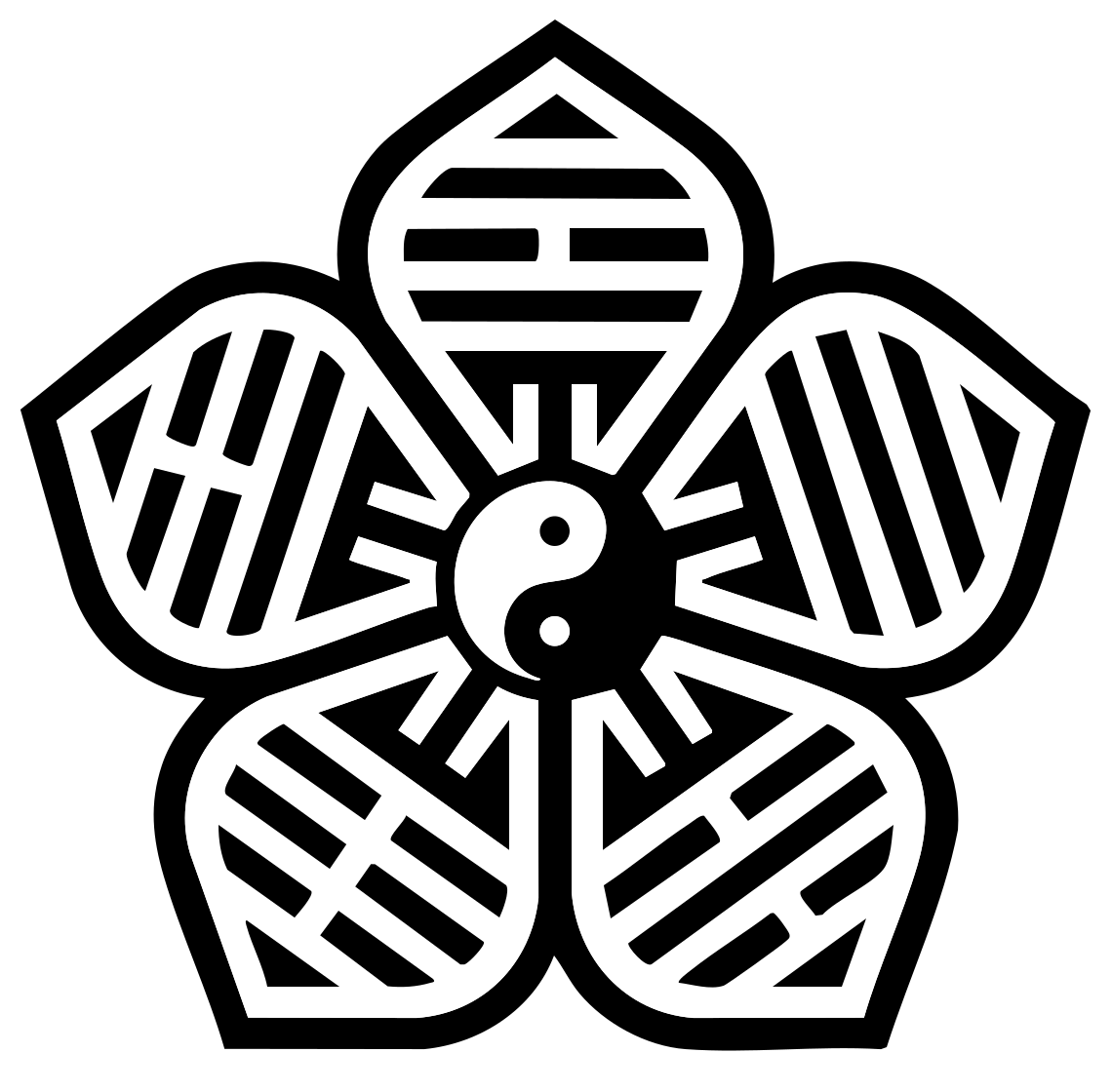
Trigram breakdown
Upper · Wind · 巽
Yin laid under two yangs. The slow press of penetration, gentle to the point of inevitability.
Lower · Water · 坎
Yang held inside two yins. The hidden current; danger and depth at once.
Judgment
'Dispersion' describes the moment when rigid, frozen, or isolated structures begin to dissolve back into flow. Wind moving over water breaks up stagnant surfaces and allows circulation to resume - this is not destruction but the release of what has become blocked or crystallized. The hexagram demands active facilitation of dissolution: crossing great waters, gathering people around a shared center, even religious or ceremonial acts that remind individuals they are part of a larger whole. What was separate must be allowed to merge and redistribute.
Image
Wind moves across the face of the water, breaking the surface tension that keeps each part locked in stillness. A slight but persistent force disperses the frozen or stagnant into movement. This teaches that dispersion is not a violent act but a gradual, pervasive influence - wind does not smash water, it coaxes it into circulation, and this is how rigid separations should be addressed.
Essence
Character
This person is made for stuck places. A frozen group, a closed-off relationship, a standoff nobody can break: they feel the pressure in it and look for the small crack. They do not push on walls. They say the thing nobody has said, or float an idea that moves the talk somewhere new. Underneath runs Water, a deep and restless feeling that keeps them tied to what people carry. The cost is a thin center. After they loosen a room, they can be carried off with it, spread across everyone's needs and unsure of their own. They do best when they keep a small, steady place to return to, and gather people around something shared rather than around themselves.
With other people
In a group, they are the one who breaks the freeze. They notice who has gone quiet and what has gone unsaid, and they bring it up lightly. The catch is that people lean on the loosening and forget the person doing it. At their best, they move things along, then point everyone toward a shared purpose and step back, leaving the group holding itself together.
Wind over Water
Water within gives them depth, feeling and a pull toward what is hidden, while Wind without carries it outward as gentle, steady influence that coaxes others into motion.
The six lines
Hexagram 59 Line 1 (59.1)
A yin line at the foundation signals that the blockage is just beginning to form, and now is exactly the right moment to intervene. Acting quickly and decisively at the first sign of hardening or isolation prevents the larger fragmentation that would follow if left unaddressed.
Hexagram 59 Line 2 (59.2)
A yang line in the second earth position brings real inner strength to the moment of early dispersal. The person rushes to their support - whether a trusted ally, a familiar refuge, or a clarifying idea - and this instinctive move dissolves the rising tension before it can solidify into a genuine crisis.
Hexagram 59 Line 3 (59.3)
A yin line in the lower human position, where action and choice are demanded, shows someone who must set aside personal concerns entirely. Dispersing any preoccupation with self-preservation or private agenda is what this transitional moment requires, and doing so creates unexpected freedom of movement.
Hexagram 59 Line 4 (59.4)
A yin line in the upper human position signals a time to disperse the group itself - to scatter old affiliations so that a larger, more integrated unity can form. This is counterintuitive but the dissolution of smaller, insular bonds is what allows connection to something genuinely greater, and that expansion is the real gain here.
Hexagram 59 Line 5 (59.5)
The ruling yang line at the peak of the hexagram carries full authority and responsibility for the work of dispersion. A strong, clear initiative - a unifying proclamation, a shared purpose, a central symbol - is issued here, and it is precisely this concentrated act of leadership that disperses confusion and realigns scattered energies around a common center.
Hexagram 59 Line 6 (59.6)
A yang line at the top, where situations tip into excess, shows dispersion reaching its outermost edge - the dissolution of danger itself. Moving decisively away from harm, or removing what is toxic from the situation altogether, is not retreat but the final intelligent act that ensures the whole process of renewal can complete safely.
Keywords:
- dissolution
- breaking isolation
- renewal
- circulation
- gathering
Relationships
Opposite
Abundance
The hexagram with every line flipped - its energetic mirror.
Inverse
Limitation
The hexagram read from the top down - its reverse-perspective.
Reverse
The Well
The hexagram with upper and lower trigrams swapped - the inside turned out.
Nuclear
The Corners of the Mouth
The hexagram built from the inner four lines (2-3-4 below, 3-4-5 above) - its inner architecture.
Family
The eight-hexagram palace it belongs to - kin generated by sequential line changes from a pure-trigram source.
Gate 59 in Human Design
In Human Design, Hexagram 59, Dispersion, is Gate 59, with the same six lines. It sits in the Sacral Center, and its one channel connects it to Gate 6 in the Solar Plexus Center. How to read your gates in the I Ching
The reading goes further down
What you have read here is the shape of Hexagram 59, 'Dispersion'.
Underneath it sit four more: the mechanic that drives it, the shadows it casts, the way through them, and the tension between Wind and Water that never quite settles.
And if this hexagram appeared in your Birth Hexagram Triad, one of its six lines is changing. That line is your growth edge, named out loud.