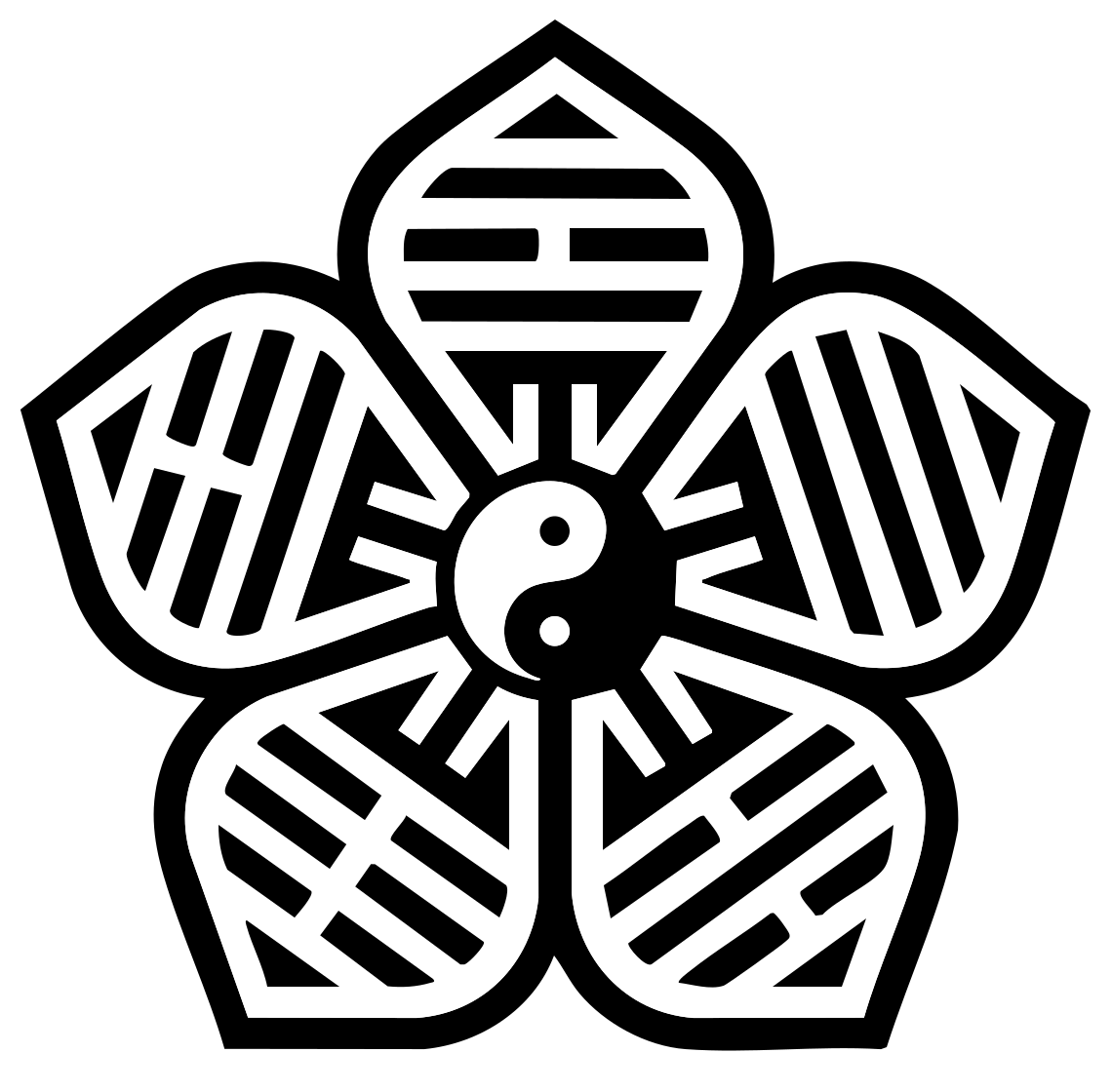
Trigram breakdown
Upper · Wind · 巽
Yin laid under two yangs. The slow press of penetration, gentle to the point of inevitability.
Lower · Mountain · 艮
Yang resting on two yins. The line that says no further. Containment as discipline.
Judgment
'Development' describes the process of genuine, irreversible growth that can only unfold through proper sequence. Wind and Wood above Mountain means that what endures must be rooted before it reaches upward - the tree growing on the mountain does not rush, and it cannot be hurried without damage. This hexagram demands patience not as passive waiting but as structural discipline: each stage must be completed before the next begins. What is built this way becomes permanent; what bypasses the stages collapses.
Image
A tree grows slowly on the face of a mountain, exposed to wind but held by deep roots. The wind does not tear it loose because it has earned its position through gradual penetration into the rock. This image teaches that genuine development follows a sequence that cannot be shortcut - each ring of growth making the next ring possible.
Essence
Character
This person builds in order and will not skip a step, even when others are already rushing ahead. They do the groundwork early and quietly, long before anyone sees it. What they make tends to stand when faster work has fallen. Patience comes easily to them, and that steadiness is what others lean on. The weak spot is preparation that never ends. There is always one more check, one more stage to finish first, and the real commitment keeps slipping. Sometimes the moment has moved on by the time the process is honored. They do best when they name the last stage out loud before they begin, so the sequence has an end and the step into the open has a date.
With other people
In a group, they become the one who keeps the order of things. They ask what has to come first, and they notice when a shortcut will cost more later. Others feel steadied by them, and sometimes held back. The catch is that their caution can read as reluctance. They play the role well when they say plainly when the groundwork is done and the group can move.
Wind over Mountain
Mountain within holds still and sends roots deep, while Wind without moves gently and reaches outward, so the person advances slowly but never loses their footing.
The six lines
Hexagram 53 Line 1 (53.1)
A yin line at the base of the mountain represents the earliest, most vulnerable stage of development. The first steps into new territory look uncertain from the outside, but beginning carefully within limits is exactly correct here, not a sign of weakness.
Hexagram 53 Line 2 (53.2)
A yin line in the second earth position finds safe ground after the uncertain start. Consolidation is the right action now - securing the position already won rather than pressing further forward, which allows genuine stability to form beneath further advance.
Hexagram 53 Line 3 (53.3)
A yang line in the third position, the lower human place, pushes toward action at a moment when the structure is not yet fully ready. Advancing too aggressively here disrupts the sequence and invites reversal - the energy is real but must be directed into preparation, not conquest.
Hexagram 53 Line 4 (53.4)
A yin line in the fourth position has moved above the mountain into exposed terrain and wisely adapts rather than forcing its way. Flexibility and the willingness to find a secure position in unconventional circumstances preserves the progress made so far.
Hexagram 53 Line 5 (53.5)
A yang line at the ruler's position holds the peak of this gradual advance, but the strength here must not become impatience. The temptation to finally move quickly now that the summit is near is the exact danger - the principle of gradual development applies most critically at the moment of apparent completion.
Hexagram 53 Line 6 (53.6)
A yang line at the top represents the culmination of the long development, where the process has moved beyond personal ambition into something that serves as a model or standard for others. The goal of gradual advancement is not just to arrive but to demonstrate a path that others can follow.
Keywords:
- gradual progress
- proper sequence
- steady growth
- patient advance
- irreversible change
Relationships
Opposite
The Marrying Maiden
The hexagram with every line flipped - its energetic mirror.
Inverse
The Marrying Maiden
The hexagram read from the top down - its reverse-perspective.
Reverse
Work on What Has Been Spoiled
The hexagram with upper and lower trigrams swapped - the inside turned out.
Nuclear
Before Completion
The hexagram built from the inner four lines (2-3-4 below, 3-4-5 above) - its inner architecture.
Family
The eight-hexagram palace it belongs to - kin generated by sequential line changes from a pure-trigram source.
Gate 53 in Human Design
In Human Design, Hexagram 53, Development, is Gate 53, with the same six lines. It sits in the Root Center, and its one channel connects it to Gate 42 in the Sacral Center. How to read your gates in the I Ching
The reading goes further down
What you have read here is the shape of Hexagram 53, 'Development'.
Underneath it sit four more: the mechanic that drives it, the shadows it casts, the way through them, and the tension between Wind and Mountain that never quite settles.
And if this hexagram appeared in your Birth Hexagram Triad, one of its six lines is changing. That line is your growth edge, named out loud.